Redefining Electronics Tray Reliability with 75–85°C High-Temperature PET Sheets
Jul 30,2026
For over 20 years, we’ve watched the electronics industry push for smaller components, tighter tolerances, and faster global supply chains. But one persistent, under-addressed problem keeps eating into margins: plastic tray deformation at elevated temperatures.
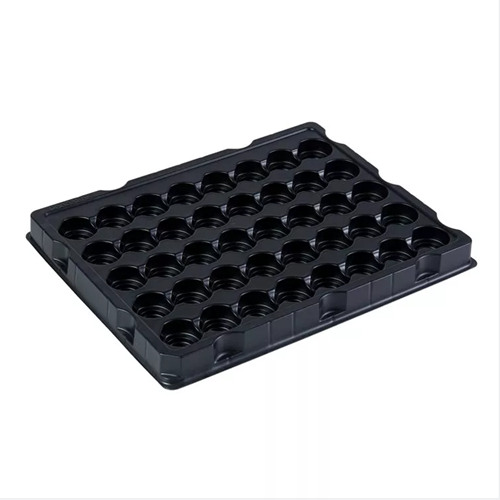
Standard PET sheets — the workhorse material for thermoformed electronics trays — softens and warps at 55–60°C. Across tropical warehouses, ocean freight containers, and SMT production floors, that threshold is crossed every day. What starts as minor warpage quickly causes misaligned pick-and-place operations, damaged semiconductors, scrapped PCB assemblies, and costly unplanned downtime.
After years of material R&D and on-line production testing, we’ve solved this exact pain point: a proprietary high-temperature PET formulation that delivers 75–85°C heat resistance under load, while retaining the dimensional accuracy, processability, and recyclability that make PET sheets the industry standard.
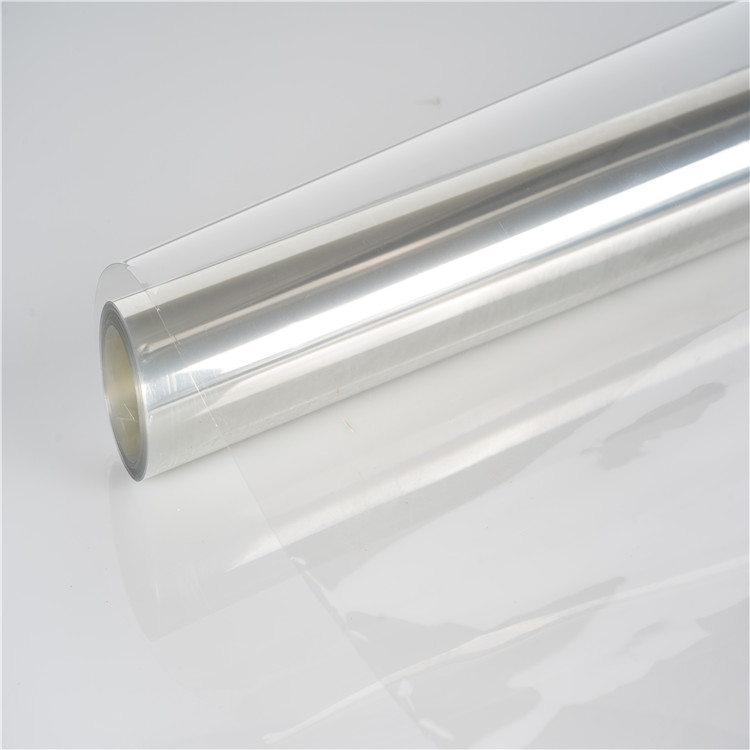
PET plastic sheet is the default choice for electronics trays for good reason: excellent rigidity, tight tolerance control, visual clarity for inspection, compatibility with anti-static coatings, and broad RoHS/REACH compliance. But its low heat deflection temperature (HDT) is a critical, costly flaw.
1.Under the weight of stacked trays, heavy components, and automated handling pressure, standard PET begins to creep and deform near 60°C. This happens routinely in:
- (1)Ocean freight containers, where internal temperatures reach 65–70°C for days at a time
- (2)Tropical warehouses and storage racks across Southeast Asia, Mexico, and the southern U.S.
- (3)Production zones near SMT reflow ovens and curing stations
- (4)Bake-out and drying processes for moisture-sensitive components
-
For precision electronics — where placement tolerances are measured in tenths of a millimeter — even slight warpage has real business consequences:
- (1)Missed pick-and-place targets and forced line stops
- (2)Bent pins and damaged fine-pitch semiconductors
- (3)Uneven tray nesting and product damage in transit
- (4)Full shipment rejections from quality assurance teams
-
For decades, the industry has accepted this as an unavoidable trade-off of using PET.
2.The Trade-Off Trap: Why Existing Fixes Fall Short
Faced with heat-related tray failure, manufacturers have historically had to compromise. None of the common alternatives deliver full value:
- (1)Polypropylene (PP) – Better heat resistance, but poor dimensional precision and rigidity. It cannot hold the micron-level cavity accuracy required for fine-pitch electronics trays.
- (2)Polycarbonate (PC) – Exceptional heat and impact performance, but 2–3x more expensive, harder to thermoform consistently, and not easily recyclable in standard waste streams.
- (3)Low-cost “heat-modified” PET blends – Boost HDT via heavy filler loading, but sacrifice impact strength, forming consistency, and surface quality critical for visual inspection.
-
Until now, you had to choose between heat resistance, precision, cost, and sustainability — never all four at once.
3.Breaking the Barrier: 75–85°C High-Temperature PET Sheets
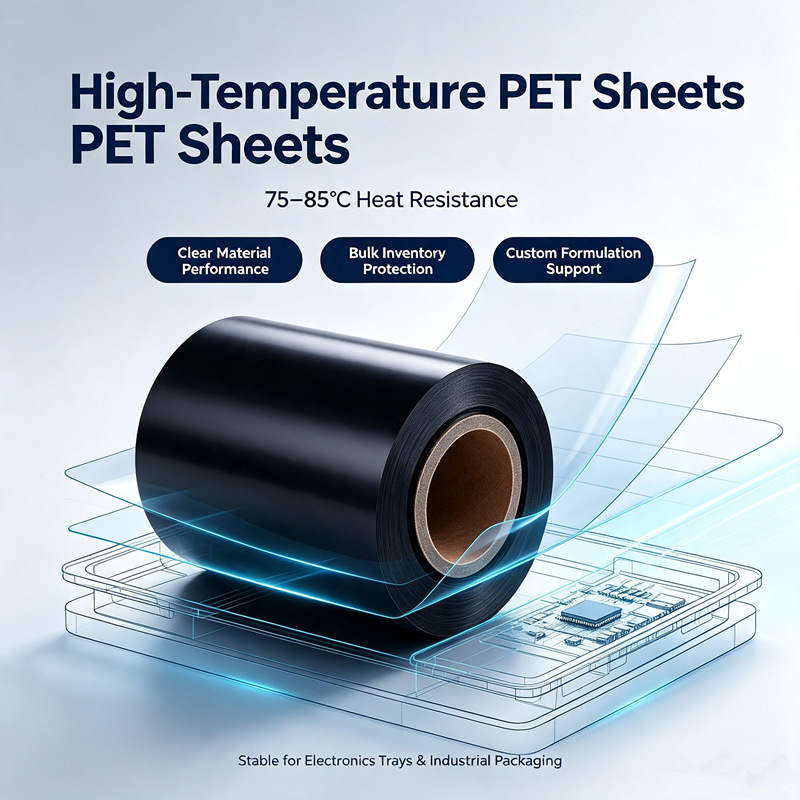
Built on 20+ years of sheet extrusion and polymer formulation expertise, our high-temperature PET sheet raises the thermal ceiling by 30–40% — without the typical trade-offs. Instead of relying on cheap fillers, we optimize polymer crystal structure and molecular chain alignment during extrusion. The result is a material that delivers:
(1)Uncompromised dimensional stability – Cavity tolerances hold steady across the full temperature range. It thermoforms on your existing PET tooling with minimal adjustment, no redesign required.
- (2)Full mechanical integrity – Retains standard PET’s rigidity, tensile strength, and impact resistance — no brittleness, no surface hazing, no loss of stacking performance.
- (3)Drop-in downstream compatibility – Works seamlessly with ESD coatings, corona treatment, printing, and ultrasonic welding, just like the PET you use today.
- (4)Built-in sustainability – 100% recyclable in standard PET streams, with optional post-consumer recycled (PCR) content to support your ESG targets.
- (5)Global regulatory compliance – Meets RoHS, REACH, and UL 94 flammability requirements, with full traceability from resin to finished sheet.
-
4.Real-World Impact: What 85°C Resistance Means for Your Bottom Line
A higher HDT isn’t just a data sheet spec — it directly reduces costs and de-risks your supply chain:
- (1)Eliminate freight and warehouse warping – Trays arrive flat and nest-perfect after equatorial shipping and tropical storage, ready for automated handling on first use.
- (2)More production floor flexibility – Stage trays near reflow ovens and drying cabinets without special cooling racks or protective handling.
- (3)Cut scrap and downtime dramatically – Early adopter customers in semiconductor and consumer electronics have reduced tray-related scrap and line stoppages by 60–80%.
- (4)Lower total cost of ownership – Priced as a premium PET grade (not a niche engineering polymer). When you factor in reduced waste, zero tooling changes, and recyclability, it often costs less than standard PET net of waste losses.
-
5.Built on 20+ Years of Industrial Sheet Expertise
This isn’t a lab experiment — it’s a production-ready material refined through decades of partnership with electronics manufacturers and thermoformers. As a global plastic sheet producer with manufacturing across Asia, we combine:
- (1)In-house R&D and pilot extrusion lines for rapid formulation tuning
- (2)Tight process control for consistent, high-volume quality
- (3)Application engineering support to test, validate, and transition your existing tray designs
- (4)Regional production for short lead times and supply chain resilience
- (5)Full customization of gauge, surface finish, ESD performance, and PCR content
-
6.Heat-Resilient Packaging for the Next Generation of Electronics
As production shifts to warmer regions and components grow more precise and valuable, standard PET’s 60°C limit will only become a bigger liability. Heat-resistant packaging is no longer a nice-to-have — it’s foundational to supply chain reliability.
Our 75–85°C high-temperature PET closes the performance gap between standard PET and costly engineering polymers, giving you the heat resistance you need without sacrificing the PET advantages you depend on.
Ready to put an end to tray warpage? Contact our technical team to request a full data sheet, order trial samples, or discuss how this material can solve your specific application challenges.
We don’t just sell sheet — we validate performance for your exact operating conditions.


 IPv6 network supported
 fullstar@xmfullstar.com
 en
en ru
ru es
es